

The View That Stops Every First-Time Visitor Cold
You are driving into Bisbee on Highway 80.
The canyon walls are narrowing. Victorian buildings are appearing on the hillsides to your left. You are already thinking about the mine tour, the restaurant you read about, the ghost tour you booked for tonight.
Then you pull over at the overlook and look right.
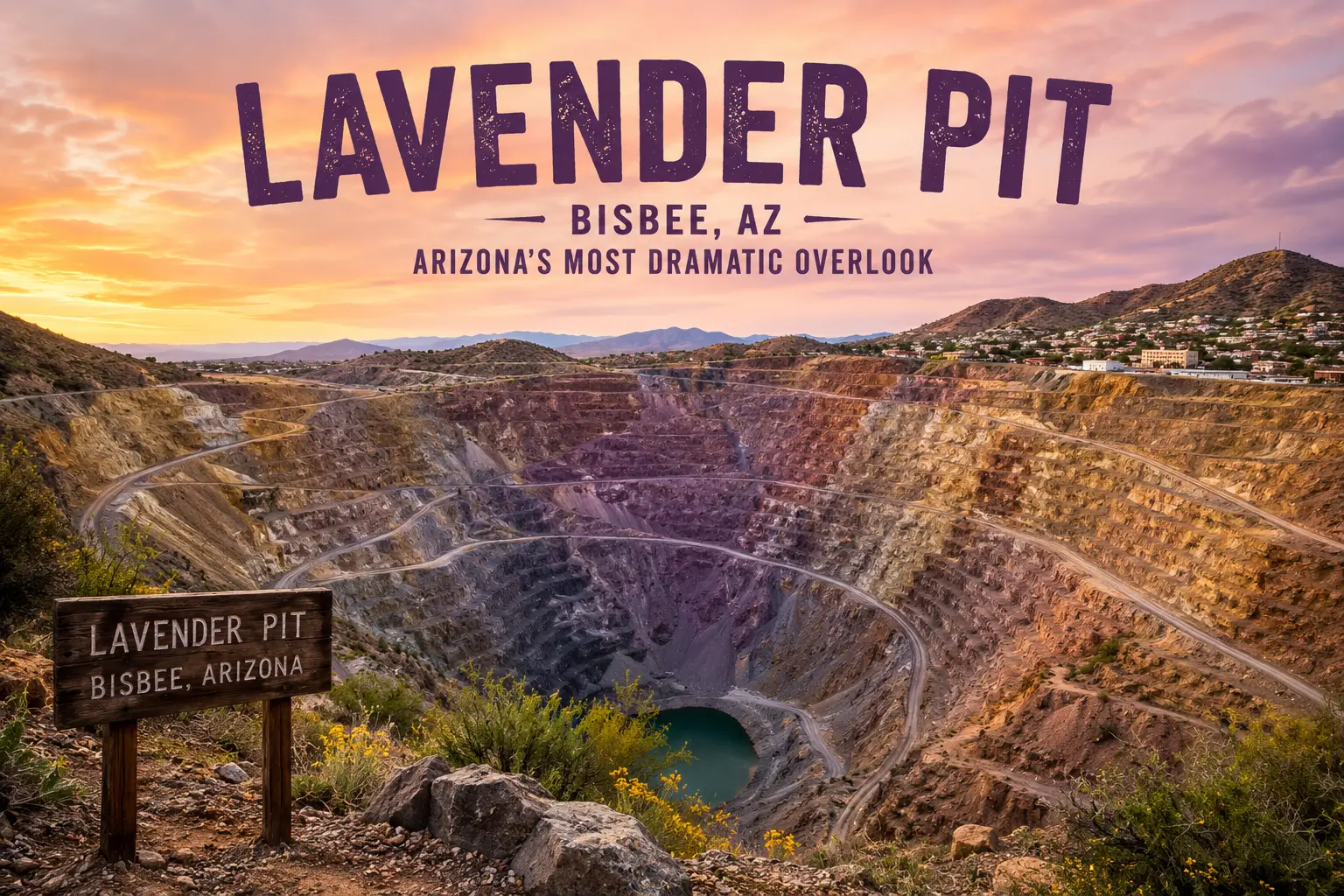
The ground simply disappears. A hole in the earth, nearly a mile wide, 900 feet deep, terraced in concentric rings of rock in shades of rust, purple, orange, and grey, drops away from the highway with a scale that is genuinely difficult to process.
This is the Lavender Pit Bisbee AZ. And it is one of the most dramatically beautiful and unsettling man-made landscapes in the American Southwest.
It is free to visit. It takes 15 minutes. It will stay in your memory for years.
This guide covers everything, the history, the extraordinary facts, the photography tips, and exactly what to do when you visit. For the complete Bisbee experience, see our guide to the best things to do in Bisbee AZ.

Table of Contents
What Is the Lavender Pit?
The Lavender Pit is a decommissioned open-pit copper mine located on the eastern edge of Bisbee’s historic district, visible from a free overlook on Highway 80 between Old Bisbee and the Lowell neighborhood.
It operated from 1950 to 1974, producing copper, gold, silver, and turquoise from one of the richest mineral deposits in North American history. When mining ceased, the pit was simply left, an industrial monument of extraordinary scale that has since become one of Bisbee’s most iconic and visited landmarks.
The numbers are staggering:
- 300 acres in total surface area
- 900 feet deep at its maximum
- 5,000 feet long, 4,000 feet wide at its widest points
- 351 million tons of material removed during operation
- 600,000 tons of copper produced over 24 years
- 75 million tons of ore extracted, averaging approximately 0.7% copper
To put the scale in perspective: the pit is almost entirely displacing the former suburb of Lowell. The neighborhood that once occupied this ground was relocated as the pit expanded.
Why Is It Called the Lavender Pit?
Almost everyone assumes the name comes from the color.
It does not.
The Lavender Pit is named after Harrison M. Lavender, an engineer who rose through the ranks of the Calumet & Arizona Mining Company, later acquired by Phelps Dodge Corporation, and became a vocal advocate for transitioning Bisbee’s copper extraction from expensive and dangerous underground mining to open-pit methods.
Lavender believed that the low-grade copper ore distributed throughout Bisbee’s subsurface rock could only be economically extracted through large-scale open-pit technology. He was right.
The pit was opened in 1950, replacing the earlier Sacramento Hill mine. Harrison Lavender passed away in 1952, two years after the pit that bore his name began operations. Mining continued for 22 more years after his death.
The irony, that a pit named for a man is now best known for its extraordinary colors, is very Bisbee.
The History: From Sacramento Hill to Open-Pit Revolution
The Sacramento Hill Mine (Before the Lavender Pit)
The Lavender Pit was not Bisbee’s first open-pit mine. That distinction belongs to the Sacramento Pit, which covered 35 acres and operated as an open pit from 1917 until 1929.
The Sacramento Pit proved that open-pit mining could work in Bisbee’s geology, but it was small. The copper reserves throughout the broader Bisbee district were far larger than a 35-acre pit could access.
The Decision to Go Big
Extensive geological research confirmed that copper ore deposits were distributed throughout the Bisbee district in a pattern resulting from a large mass of intrusive granite porphyry pushed up into surrounding schist and limestone. The copper was deposited in limestone traps, forming ore bodies, but at low concentrations that made underground mining increasingly uneconomical.
Phelps Dodge’s solution was to think at a different scale entirely.
In 1950, work began on a new open pit at the site of Sacramento Hill, ten times the size of the original. The excavation used electric-powered shovels four times larger than the old steam-powered ones and replaced rail-track ore cars with trucks capable of carrying 35 to 65 tons.
24 Years of Operation
The Lavender Pit operated continuously from 1950 to 1974. At its peak it employed hundreds of workers, extracting ore at a scale that made the underground Copper Queen Mine look modest by comparison.
Copper production totaled approximately 600,000 tons over the pit’s operational life. Gold and silver were extracted as byproducts. And Bisbee Blue turquoise, now one of the rarest and most valuable gemstones in the world, was a byproduct of this mining activity.
When the price of copper plummeted in the early 1970s, Phelps Dodge ended operations. Mining in the Lavender Pit ceased in 1974, followed by closure of the underground Copper Queen Mine in 1975.
The pit was left exactly as it was. It has remained open to public viewing ever since.
The Retirement Community That Never Was
In October 1977 just three years after mining ended, a security guard named George Nellis proposed utilizing the Lavender Pit to build a terraced retirement community housing 100,000 people.
The idea never came to fruition. But it captures something true about Bisbee’s post-mining resilience: the pit was too dramatic a landscape to simply write off, and the town that surrounded it was too stubborn to simply disappear.
What Makes the Lavender Pit So Visually Extraordinary
The colors are the first thing that stops visitors.
Unlike most industrial sites, the Lavender Pit is not grey. The terraced walls glow in extraordinary colors that shift with the time of day and season, rust reds, dusty purples, vivid oranges, pale yellows, and the blue-green streaks of copper carbonate mineralization.
These colors are the direct result of the pit’s extraordinary mineralogy. The Bisbee mining district is one of the most mineralogically diverse sites in the world, with over 320 documented mineral species. The visual variety in the pit walls reflects that diversity.
The colors explained:
- Rust and red: Iron oxides, hematite and goethite, the most common surface minerals
- Purple and grey: The predominant rock matrix, a mix of altered limestone and granite porphyry
- Blue-green streaks: Malachite and azurite, copper carbonates that formed as copper ore oxidized near the surface
- Yellow-orange: Limonite and other iron hydroxides
Because of the exceptionally hard host rock, the Lavender Pit has much steeper sides than other open-pit copper mines in the American Southwest. The bench cuts, each 50 feet high, are clearly visible from the overlook, giving the pit its distinctive terraced appearance.
Visiting the Lavender Pit Bisbee AZ
The Overlook
Location: Highway 80, between Old Bisbee and the Lowell neighborhood Admission: Free Hours: Open 24 hours, 7 days a week
The Lavender Pit overlook is a pull-off area on Highway 80 with a paved viewing area, interpretive signs, and unobstructed views of the entire pit.
There is no gate, no ticket booth, and no closing time. You simply pull over, walk to the viewing area, and look.
The drive from Old Bisbee’s main district takes about two minutes. The drive from the Queen Mine Tour building takes about one minute. There is no reason not to stop.
How Long to Spend
Plan for 15–30 minutes at minimum. The first five minutes is processing the scale. The next ten is looking for details — the color variations, the bench levels, the water pooling at the bottom. The last ten is photographs.
If you have a particular interest in geology, mining history, or photography, you can easily spend an hour here.
Photography Tips
The Lavender Pit is one of the most photogenic industrial landscapes in Arizona. A few tips for getting the best images:
Best time of day: Late afternoon (2–5 PM) when the sun illuminates the western walls and brings out the rust and purple tones most dramatically. Morning light is flatter but still beautiful.
Best angle: The main overlook provides the widest view. Walk to the far left and far right edges of the viewing area for slightly different perspectives that emphasize different sections of the pit.
Foreground interest: Include the interpretive signage, the fence line, or a person for scale. The pit is so large that without a foreground element for scale, photographs often fail to convey its actual size.
Smartphone vs camera: The pit’s scale works well with wide-angle lenses. Most modern smartphone cameras capture it effectively. A polarizing filter (if shooting with a camera) dramatically enhances the color contrast in the pit walls.
Golden hour: Arrive 30 minutes before sunset for the most dramatic lighting conditions. The pit walls turn deep amber and the shadow patterns across the bench cuts become particularly striking.
The Lavender Pit and Bisbee Blue Turquoise
One of the Lavender Pit’s lesser-known stories is its connection to one of the world’s finest gemstones.
Bisbee Blue turquoise extracted as a byproduct of copper mining operations in the Lavender Pit, is among the finest turquoise found anywhere in the world. It is characterized by its vivid electric blue color and distinctive chocolate-brown spiderweb matrix, which forms from the unique mineral chemistry of the Bisbee deposit.
Mining of the Lavender Pit stopped in 1974. No new Bisbee Blue is being extracted. The supply is finite and declining, which has driven prices for authenticated Bisbee turquoise steadily upward for decades.
Top-quality Bisbee Blue can sell for hundreds to thousands of dollars per stone. Even smaller, more accessible pieces carry a premium.
You can find authenticated Bisbee Blue turquoise at galleries and jewelry shops throughout Old Bisbee’s Main Street, and at the Queen Mine Store. Always request provenance documentation when purchasing.
The Lavender Pit in Context: Bisbee’s Full Mining Story
The Lavender Pit is one piece of a larger story.
The underground Copper Queen Mine, accessible via the Queen Mine Tour tells the first chapter: 95 years of underground copper mining through 143 miles of tunnels.
The Lavender Pit tells the second chapter: 24 years of open-pit mining on a scale that literally reshaped the landscape.
Together, they account for over 8 billion pounds of copper, 102 million ounces of silver, and 2.8 million ounces of gold extracted from this single canyon in the Mule Mountains of southeastern Arizona.
Visiting both the underground tunnels in the morning and the open pit overlook in the afternoon, gives you the full sweep of one of the most remarkable industrial histories in the American West.
Lavender Pit vs. Queen Mine Tour: Do Both
The most common question visitors ask is whether to do the Lavender Pit or the Queen Mine Tour.
The answer is both, and they are entirely different experiences.
The Lavender Pit is free, takes 15–30 minutes, and is a visual and geological experience. You stand above and look down at the scale of open-pit mining.
The Queen Mine Tour costs $25 for adults, takes 75 minutes, and is a deeply personal historical experience. You go underground with a former miner who worked these tunnels and hear stories that have never been written down.
They complement each other perfectly. Do the Queen Mine Tour in the morning. Stop at the Lavender Pit overlook before or after lunch. The combined picture of Bisbee‘s mining history that emerges from both visits is more complete and more powerful than either alone.
FAQs: Lavender Pit Bisbee AZ
Is the Lavender Pit free to visit?
Yes, completely free, open 24 hours, seven days a week. Pull off Highway 80 between Old Bisbee and the Lowell neighborhood.
Why is the Lavender Pit purple and colorful?
The extraordinary colors come from the pit’s exceptional mineralogy, over 320 mineral species documented in the Bisbee mining district. Rust reds come from iron oxides; blue-green streaks are copper carbonates (malachite and azurite); purple and grey tones come from the altered rock matrix.
Why is it called the Lavender Pit?
It is named after Harrison M. Lavender, the Phelps Dodge engineer who pioneered open-pit mining in Bisbee. He passed away in 1952, two years after operations began.
How deep is the Lavender Pit?
The pit is 900 feet deep, covers 300 acres, and is approximately 5,000 feet long by 4,000 feet wide at its largest dimensions.
Can you go into the Lavender Pit?
No, the pit itself is on private property and not open for entry. The public viewing overlook on Highway 80 provides clear, unobstructed views of the entire pit.
Is the Lavender Pit the same as the Queen Mine?
No. The Lavender Pit is an open-pit mine that operated 1950–1974. The Queen Mine (Copper Queen Mine) is an underground mine that operated 1877–1975. The Queen Mine Tour takes visitors underground by mine train. The Lavender Pit is viewed from a surface overlook.
Have a photograph of the Lavender Pit you are proud of? Tell us about your visit in the comments.
Quick Facts: Lavender Pit Bisbee AZ
| Detail | Fact |
|---|---|
| Location | Highway 80, between Old Bisbee and Lowell |
| Admission | Free |
| Hours | Open 24 hours |
| Depth | 900 feet |
| Surface area | 300 acres |
| Operated | 1950–1974 |
| Named for | Harrison M. Lavender, Phelps Dodge engineer |
| Copper produced | ~600,000 tons |
| Material removed | 351 million tons |
| Best photo time | Late afternoon (2–5 PM) |