

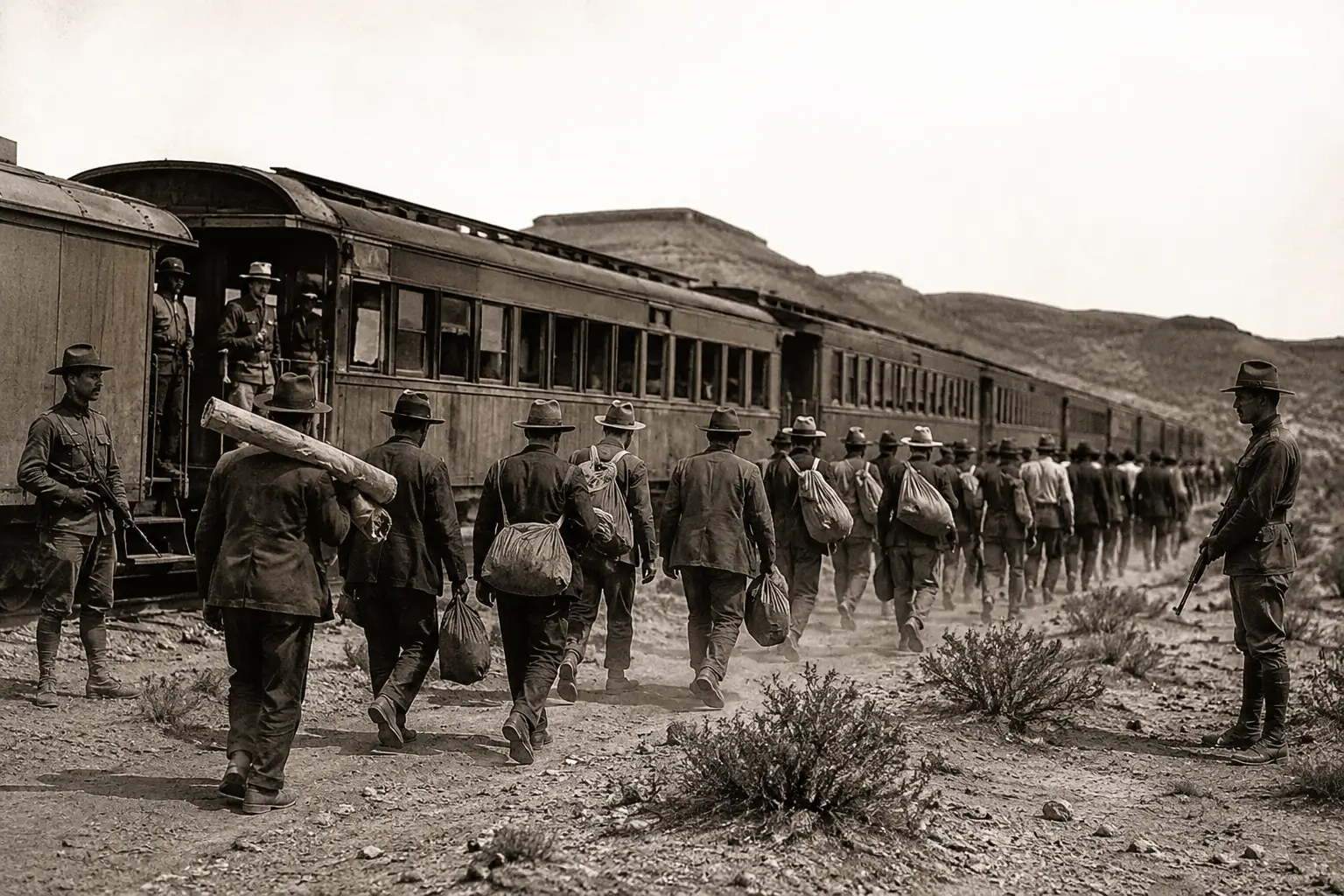
At 4:00 AM on July 12, 1917, approximately 2,000 armed men fanned out through the residential neighborhoods of Bisbee, Arizona, and the nearby suburb of Warren. They carried rifles and shotguns. They wore white armbands for identification. They had deputization papers signed by Cochise County Sheriff Harry Wheeler.
And over the next several hours, they systematically rounded up 1,286 men, mostly striking miners affiliated with the Industrial Workers of the World, marching them at gunpoint to a baseball field in Warren.
By early afternoon, the men had been loaded onto cattle cars belonging to the El Paso and Southwestern Railroad. The train carried them 173 miles east into the New Mexico desert and deposited them near the tiny settlement of Hermanas, where they were told at gunpoint not to return to Arizona. No charges had been filed. No court had issued any order. No state or federal authority had authorized the action.
The Bisbee Deportation 1917 remains one of the most extreme examples of corporate-organized extrajudicial violence against labor in American history. It is also a story that Bisbee itself has spent over a century grappling with, acknowledging, examining, and still, in some quarters, defending.
Background, The IWW and Copper Mining in 1917
To understand the Deportation, you need to understand the conditions that produced it.
By 1917, copper mining in Bisbee was one of the most profitable industrial operations in the American Southwest. The Copper Queen mine and the adjacent properties controlled by Phelps Dodge Corporation were producing copper at extraordinary rates, driven by World War I demand. The price of copper had more than doubled since 1914. Phelps Dodge’s profits were staggering.
The miners who produced this copper were not sharing proportionally in this prosperity. Working conditions in the underground mines were genuinely dangerous: silicosis from rock dust was endemic, cave-ins were frequent, and the company’s safety record was poor by any contemporary standard. Wages had not kept pace with wartime inflation or with the company’s profits.
Into this situation came the Industrial Workers of the World, the IWW, commonly called the Wobblies, a radical labor union that had organized workers across extractive industries in the American West since its founding in 1905.
The IWW’s philosophy was explicitly revolutionary: the organization of all workers into a single industrial union, the abolition of the wage system, and the eventual worker ownership of industry.
These positions, combined with the IWW’s multiracial organizing (the union explicitly welcomed Black, Mexican, and immigrant workers that the more established American Federation of Labor often excluded), made it anathema to both the corporations and to the wartime federal government.
On June 27, 1917, the IWW’s Metal Mine Workers’ Union No. 800 called a strike at the Bisbee mines. Approximately 3,000 miners walked out.
The demands were not revolutionary: a $6 daily minimum wage (up from $5.50), elimination of the two-man drill requirement that most miners felt increased silicosis risk, an end to the physical examination system that the company used to blacklist union organizers, and equal treatment for Mexican workers.
Phelps Dodge refused to negotiate.
Table of Contents
The Planning, Walter Douglas and Harry Wheeler
The Deportation did not happen spontaneously. It was planned.
Walter Douglas, president of Phelps Dodge, coordinated with Cochise County Sheriff Harry Wheeler in the weeks before July 12. Douglas organized the Citizens’ Protective League, a vigilante organization of company foremen, local businessmen, and anti-union miners, and equipped them.
Wheeler provided the legal cover of deputization, though the legal basis for deputizing 2,000 armed civilians to conduct a mass arrest without warrants or charges was, as federal investigators would later document, nonexistent.
The justification offered by Douglas and Wheeler, that the strike was a German-financed sabotage effort against American war production — was asserted without evidence and has never been substantiated by any historical investigation. The wartime context (America had entered World War I in April 1917) provided rhetorical cover for what was, in substance, a corporate action to break a labor union.
July 12, The Bisbee Deportation 1917
The roundup began at 4 AM. The armed posse moved through the Bisbee and Warren neighborhoods, knocking on doors, pulling men from beds, and marching them at gunpoint through the streets.
Men who refused to come were physically forced out; one man, James Brew, was shot and killed when he attempted to resist with a firearm. Several of the posse were also killed or wounded in isolated confrontations during the roundup.
The men were marched to the Warren baseball field, approximately a mile, and held through the morning heat while the posse sorted them. Men who could prove they were not striking or not IWW members were released. The remainder, 1,186 according to the train manifest, though various sources give figures between 1,186 and 1,286, were loaded onto cattle cars.
The process of loading men onto the cars, documented in photographs taken by Bisbee residents, shows the scale clearly: a line of men stretching hundreds of yards, armed guards at intervals, the cattle cars of the El Paso and Southwestern railroad waiting on the sidings.
The train moved east. It stopped briefly at various points where local authorities refused to take the deportees. It continued to Hermanas, New Mexico, a desert settlement with minimal infrastructure, where the deportees were unloaded and told that returning to Arizona would result in shooting.
The federal government, under pressure from labor organizations and liberal political figures, eventually sent Army troops to provide the deportees with food, water, and protection. A makeshift camp was established at Columbus, New Mexico, where the men were held for weeks.
The Aftermath, No Justice, Permanent Consequences
President Woodrow Wilson appointed a Presidential Mediation Commission, led by Felix Frankfurter (later a Supreme Court Justice), to investigate the Deportation. The Commission’s 1918 report condemned the Deportation clearly: it was “wholly illegal,” conducted without any legal authority, and could not be justified by any claimed emergency.
No criminal charges were ever brought against Walter Douglas, Harry Wheeler, or any of the 2,000 members of the posse.
The Cochise County Grand Jury indicted 224 deportation participants on kidnapping charges. The Arizona Supreme Court dismissed the indictments, ruling that the state courts lacked jurisdiction because the deportees had been taken out of state.
A federal case was constructed on different grounds. The Supreme Court of the United States, in United States v. Wheeler (1920), ruled that the federal government lacked constitutional authority to prosecute the deporters under the federal laws available at the time — that the crime, if it was a crime, was a state matter. Since the state courts had declined jurisdiction, the result was complete impunity.
The deportees did not return to Bisbee in significant numbers. The IWW was effectively destroyed in Bisbee. The strike was broken. Phelps Dodge continued operating the mines without a union until the 1940s, when the International Union of Mine, Mill and Smelter Workers (an AFL affiliate) finally organized the operations.
Historical Significance, Why This Story Matters
The Bisbee Deportation has been studied by legal scholars, labor historians, and civil liberties historians for a century, and the conclusions consistently point to the same set of lessons:
The limits of corporate power, and its absence: The Deportation demonstrated that in 1917, a large corporation with local political connections could organize what was effectively a private army, conduct a mass extrajudicial deportation of over a thousand American citizens, and face no criminal consequence. The legal system at every level declined to prosecute.
The wartime suppression of labor: The IWW was targeted across the United States in 1917–1918 under the Espionage Act and various state sedition laws. The Bisbee Deportation occurred in this context, but its organizers acted before any federal action was taken against the Bisbee IWW, and the “German financing” justification was never evidenced. The Deportation was corporate anti-unionism using the wartime emergency as cover.
The racial dimension: Many of the deported men were Mexican and Mexican-American workers. The Citizens’ Protective League’s internal documents suggest that the organizers were specifically targeting workers who had crossed racial lines by joining the IWW’s explicitly integrated union structure. The Deportation fits within the broader pattern of violence used to enforce racial labor hierarchies in the early 20th-century Southwest.
Precedent for legal scholarship: United States v. Wheeler remains a significant case in constitutional law courses for the questions it raised, and left unresolved, about federal authority to protect citizens’ constitutional rights against private actors.
The Deportation in Bisbee’s Memory
Bisbee’s relationship with its own Deportation history has evolved significantly over the past century. In the decades immediately following 1917, the dominant Bisbee narrative, shaped heavily by Phelps Dodge’s community influence, treated the Deportation as a justified wartime emergency measure. This narrative was taught in Bisbee schools and reflected in local commemoration.
As the arts community that reinvented Bisbee after the mine closure was politically progressive and historically engaged, the community’s self-understanding began to shift. By the late 20th century, the Deportation had become central to Bisbee’s historical identity, acknowledged, studied, and increasingly honored rather than justified.
The Bisbee Mining & Historical Museum’s permanent exhibition on the Deportation, carefully researched and honestly presented, is the most thorough public interpretation of the event available anywhere. It treats the Deportation as the historical atrocity it was, while acknowledging the complexity of the community that both produced and survived it.
In 2017, on the centennial of the Deportation, Bisbee held a commemoration that brought together descendants of deportees, labor historians, and community members. The mayor issued a formal apology on behalf of the city. The commemoration attracted national media attention.
How to Learn More About the Bisbee Deportation
At the Bisbee Mining & Historical Museum: The most comprehensive public interpretation of the Deportation, with original documents, photographs, and the full story told without apology. The museum is at 5 Copper Queen Plaza in downtown Bisbee.
The 1917 film “Bisbee ’17”: Director Robert Greene’s 2018 documentary, which won the Grand Jury Prize at the SXSW Film Festival, reconstructed the Deportation using Bisbee residents as participants and combined documentary and reenactment approaches to explore how the community remembers the event. Required viewing for anyone seriously interested in the history.
Academic sources: The most comprehensive historical account is in “Bisbee: Queen of the Copper Camps” by Lynn Bailey. James Byrkit’s “Forging the Copper Collar: Arizona’s Labor-Management War of 1901–1921” provides the broader labor context. Felix Frankfurter and Roscoe Pound’s 1918 “Report on the Bisbee Deportation” is the primary source federal investigation document.
Visiting Bisbee With the Deportation in Mind
Walking Bisbee with knowledge of the Deportation changes what you see. The Warren neighborhood, where many of the deported men lived, is accessible from Old Bisbee via AZ-80.
The baseball field where the men were held before being loaded onto the train no longer exists, but the general area is visible. The Phelps Dodge general office building, now the Mining & Historical Museum, was the administrative headquarters of the men who organized the Deportation.
None of this is marked with the kind of prominent public signage that the historical weight warrants. That’s partly Bisbee’s ongoing negotiation with its own history, and partly the nature of a living community’s relationship to its most difficult moments. The Mining Museum fills the interpretive gap as well as any institution could.
→ Plan your visit:| Best Things to Do in Bisbee AZ | Bisbee Arizona History
Frequently Asked Questions
What was the Bisbee Deportation of 1917?
The Bisbee Deportation was an extrajudicial mass roundup conducted on July 12, 1917, in which approximately 2,000 armed vigilantes organized by Phelps Dodge Corporation and deputized by Cochise County Sheriff Harry Wheeler rounded up 1,186–1,286 striking miners and deported them by cattle car to the New Mexico desert. No charges were filed and no one was prosecuted.
Was anyone punished for the Bisbee Deportation?
No one was ever criminally convicted for the Bisbee Deportation. Federal and state courts declined jurisdiction on different grounds, and the organizers, Walter Douglas of Phelps Dodge and Sheriff Harry Wheeler, faced no legal consequences.
Why did the Bisbee Deportation happen?
The proximate cause was a strike by the IWW against the Phelps Dodge copper mines demanding better wages and safer working conditions.
The deeper causes were Phelps Dodge’s refusal to negotiate with unions, the wartime political climate that provided cover for anti-labor action, and the corporation’s ability to organize private extrajudicial violence without facing legal consequences.
How many people were deported in the Bisbee Deportation?
The train manifests document 1,186 deportees. Various historical sources cite figures between 1,186 and 1,286, with the difference reflecting men released before loading and the difficulty of exact documentation during a chaotic event. The figure of 1,286 is most commonly cited.
A Story Worth Knowing
The Bisbee Deportation is not a comfortable piece of American history. It involves corporate violence, legal impunity, wartime suppression of dissent, and racial targeting, elements that are not unique to 1917 and not unique to Arizona.
Understanding it makes Bisbee a richer place to visit. The mining museum becomes more than an artifact collection; it becomes a record of what people did to each other and what a community chose to remember. The Victorian buildings on Main Street were built with money extracted from the labor of men who were eventually expelled at gunpoint for asking for better conditions.
That context doesn’t diminish Bisbee’s beauty or its character. It deepens them.
→ Go deeper into Bisbee’s history: Bisbee Arizona History | Queen Mine Tour Bisbee AZ | Best Things to Do in Bisbee AZ
Last updated: June 2026 |